
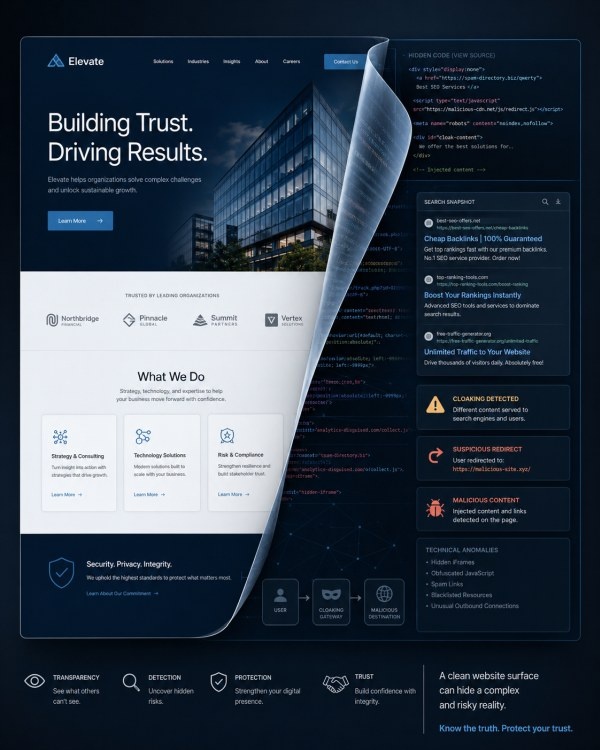
Your Website May Look Fine. But What Does Google Actually See?
Many business owners judge their website by what they can see.
The homepage loads. The design looks clean. The menu works. The company profile is still there. The contact form appears normal.
On the surface, everything looks fine.
But a website can look perfectly normal to human visitors while showing something very different to search engines.
This is where many businesses misunderstand website health.
A website is not only judged by what the business owner sees. It is also judged by what Google sees, what search engine bots crawl, what pages are indexed, what code exists behind the surface, and whether the website is still technically clean and trustworthy.
For a company that depends on its website for credibility, enquiries, SEO, and brand trust, this is not a small technical issue.
It is a business trust issue.

The Website You See May Not Be the Website Google Sees
When a normal visitor opens a website, they usually see the front layer.
They see the design, images, content, navigation, and contact information.
But search engine bots do not only look at the website visually. They crawl the website structure, code, links, hidden pages, redirects, metadata, indexed URLs, and server responses.
That means Google may detect issues that are invisible to normal users.
For example, a business website may appear clean to visitors, but search engines may detect:
malicious code injection
hidden spam pages
suspicious redirects
cloaking issues
gambling-related indexed content
hacked pages
abnormal outbound links
duplicate or polluted SEO metadata
compromised WordPress files or plugins
To a human visitor, the website still looks like a professional corporate website.
To Google, it may look like a spam website.
That is a serious problem.
Why This Matters for SEO
Many companies invest in SEO for months without seeing meaningful improvement.
The common assumption is:
“Our keywords are not strong enough.” “Our content is not enough.” “Our SEO agency is not doing enough.” “Our competitors are spending more.”
Sometimes those reasons may be valid.
But sometimes, the real problem is more fundamental:
The website itself may already be compromised.
If Google detects suspicious content, cloaking behaviour, malicious pages, spam links, or abnormal indexing patterns, the website’s trustworthiness may be affected.
When that happens, publishing more content may not solve the problem.
Adding more keywords may not solve the problem.
Running more ads may not solve the problem.
Because the issue is not only visibility.
The issue is trust.
SEO is not just about ranking. It is also about whether search engines can trust the website enough to crawl, understand, and recommend it properly.
A polluted website is like a damaged reputation.
You can keep promoting it, but the underlying trust problem remains.

What Is Cloaking and Why Should Business Owners Care?
Cloaking happens when a website shows different content to users and search engines.
For example:
A human visitor sees a normal company website. But a search engine bot sees spam content, gambling content, suspicious keywords, or injected pages.
This can happen intentionally in black-hat SEO, but it can also happen because a website has been hacked or infected.
From a business owner’s perspective, this is dangerous because the website may appear normal during a casual check.
The company may not notice anything wrong.
The team may continue investing in SEO, content, or advertising.
But behind the surface, search engines may already be reading a very different version of the website.
This is why “the website looks okay” is not a complete website audit.
It is only a surface-level observation.
A Corporate Website Is Part of Digital Trust
For many companies, the website is no longer just an online brochure.
It is often the first place where customers, partners, suppliers, investors, job candidates, and stakeholders form an impression of the business.
A corporate website affects how people judge:
whether the company looks professional
whether the company is active and credible
whether the company can be trusted
whether the brand is mature
whether the business is well managed
whether it is safe to contact, buy from, or work with the company
This is why website security and technical cleanliness should not be treated only as IT matters.
They are part of corporate credibility.
A website that is infected, polluted, slow, outdated, or poorly maintained does not only create technical risk.
It creates trust risk.
And trust risk can quietly affect enquiries, conversions, rankings, brand perception, and customer confidence.
The Three-Layer Website Check Every Business Should Understand
When reviewing a business website, it is not enough to only ask whether the website looks nice.
A proper review should look at three layers.
1. What Users See
This is the visible layer.
It includes the design, layout, content, images, navigation, mobile responsiveness, loading experience, and contact path.
This layer matters because customers judge professionalism quickly.
If the website looks outdated, confusing, or incomplete, customers may hesitate before contacting the company.
But this is only the first layer.
2. What Google Sees
This is the search engine layer.
It includes indexed pages, page titles, meta descriptions, structured content, internal links, crawlability, redirects, canonical URLs, sitemap quality, and whether Google is discovering any abnormal pages.
This layer matters because Google may see things that users do not.
A website may look normal visually but still have strange indexed URLs, spam snippets, injected keywords, or suspicious pages in search results.
Business owners should occasionally check how their website appears in search results, not only how it appears in the browser.
3. What Happens Behind the Website
This is the backend and technical layer.
It includes CMS health, plugin updates, server configuration, file integrity, malware scanning, access control, database condition, security headers, redirects, and hosting stability.
This layer matters because many website problems begin quietly.
By the time the issue becomes visible, the damage may already have affected SEO, user trust, or business continuity.
Why Looking “Normal” Is Not Enough
A website can look normal and still be unhealthy.
This is the uncomfortable truth many businesses overlook.
A normal-looking website may still have:
outdated plugins
vulnerable scripts
infected files
hidden spam pages
poor indexing control
broken redirects
weak security settings
duplicated pages
suspicious search snippets
compromised admin access
The danger is that business owners often only respond when the problem becomes obvious.
But by then, the website may already have lost search visibility, trust signals, or customer confidence.
In website strategy, early diagnosis is always better than late repair.
Warning Signs That Your Website May Need a Deeper Audit
A business should consider a deeper website audit if it notices any of the following:
SEO ranking drops without a clear reason
strange pages appearing in Google search results
spammy titles or descriptions showing in search snippets
sudden increase in indexed pages
website traffic dropping unexpectedly
Google Search Console warnings
security warnings from browsers or hosting providers
customers reporting strange redirects
website forms receiving abnormal spam
unfamiliar admin users or files in the backend
SEO work continuing for months without progress
Not every issue means the website is hacked.
But these are signals that the website should not be judged only by appearance.
Before Spending More on SEO, Check the Foundation
Many companies treat SEO as a marketing activity.
That is understandable.
But SEO also depends on the technical and trust foundation of the website.
Before investing more into SEO, content, or digital advertising, businesses should ask:
Is the website technically clean? Is Google indexing the right pages? Are there any suspicious URLs? Are redirects properly managed? Is the website secure and maintained? Does the backend show any signs of compromise? Is the website helping customers trust the company?
If the foundation is weak, more marketing may simply drive more attention to a weak asset.
That is not strategy.
That is expensive noise.
Website Health Is a Business Responsibility
For business leaders, the key lesson is simple:
Do not judge your website only by what you can see.
A website is a business asset, but only if it remains trustworthy, secure, clear, and properly maintained.
If it is polluted or compromised, it can quietly damage SEO, brand perception, and customer confidence.
A healthy website should support three things:
Customers should understand the business clearly.
Search engines should crawl and index the right content.
The backend should remain clean, secure, and stable.
When these three layers work together, the website becomes more than a digital brochure.
It becomes a trust asset.
Final Thought
Your website may look normal to you.
But the more important question is:
Does it look normal to Google?
Because in today’s digital environment, what search engines see can affect what customers eventually find, trust, and choose.
A professional website is not only about how it looks on the surface.
It is about whether the business can be trusted behind the surface.
